Research Notes
Research at Nsoh Research is conducted using Agile-Infused Design Science Research Methodology (A-DSRM), with contributions expressed as artifacts rather than abstractions alone. Each research effort begins with a real-world problem observed in industry or critical infrastructure, followed by the design, build, and evaluation of security artifacts—such as identity architectures, AI-driven detection pipelines, and Zero Trust control models—under operational and adversarial constraints.
A-DSRM Methodology
Research at Nsoh Research is conducted using Agile-Infused Design Science Research Methodology (A-DSRM), where contributions are expressed as artifacts rather than abstractions alone. Each research effort begins with a real-world problem observed in industry or critical infrastructure, followed by the design, build, and evaluation of security artifacts—such as identity architectures, AI-driven detection pipelines, and Zero Trust control models—under operational and adversarial constraints. A-DSRM treats problem evolution as a first-class variable, preserving validity through continuous iteration, collaborative feedback, and evidence-driven refinement.
✦What Makes A-DSRM Different
Iteration is required, not optional: every cycle refines both the artifact and the problem framing.
Adversarial drift (φ) is expected: threat adaptation and operational change actively shape objectives and design.
IAM is the enforceable control plane: agentic and system actions are bound to authenticated, authorized, and revocable policy.
Collaboration is structural: practitioners, researchers, and students co-produce artifacts, evidence, and deployment guidance.
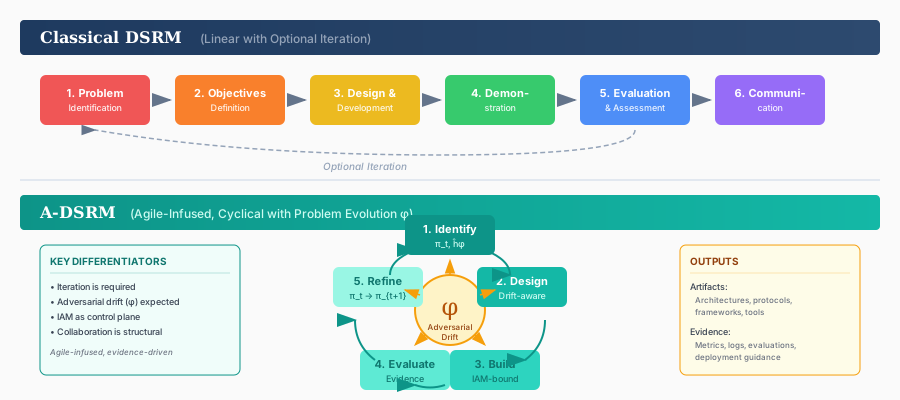
Classical DSRM (linear with optional iteration) versus A-DSRM (cyclical with integrated problem evolution φ).
Agile Infusion (A-DSRM is not waterfall DSRM)
A-DSRM incorporates agile principles adapted for research contexts: iterative delivery of working artifacts, responsiveness to change without treating evolution as scope creep, tight collaboration between researchers and practitioners, and cycle durations calibrated to the rate of threat evolution and research capacity. Agile infusion represents a shift from research as linear knowledge production to research as continuous adaptive response.
Research Series
Showing 6 research notes